


The Statue of Liberty and the Empire State Building
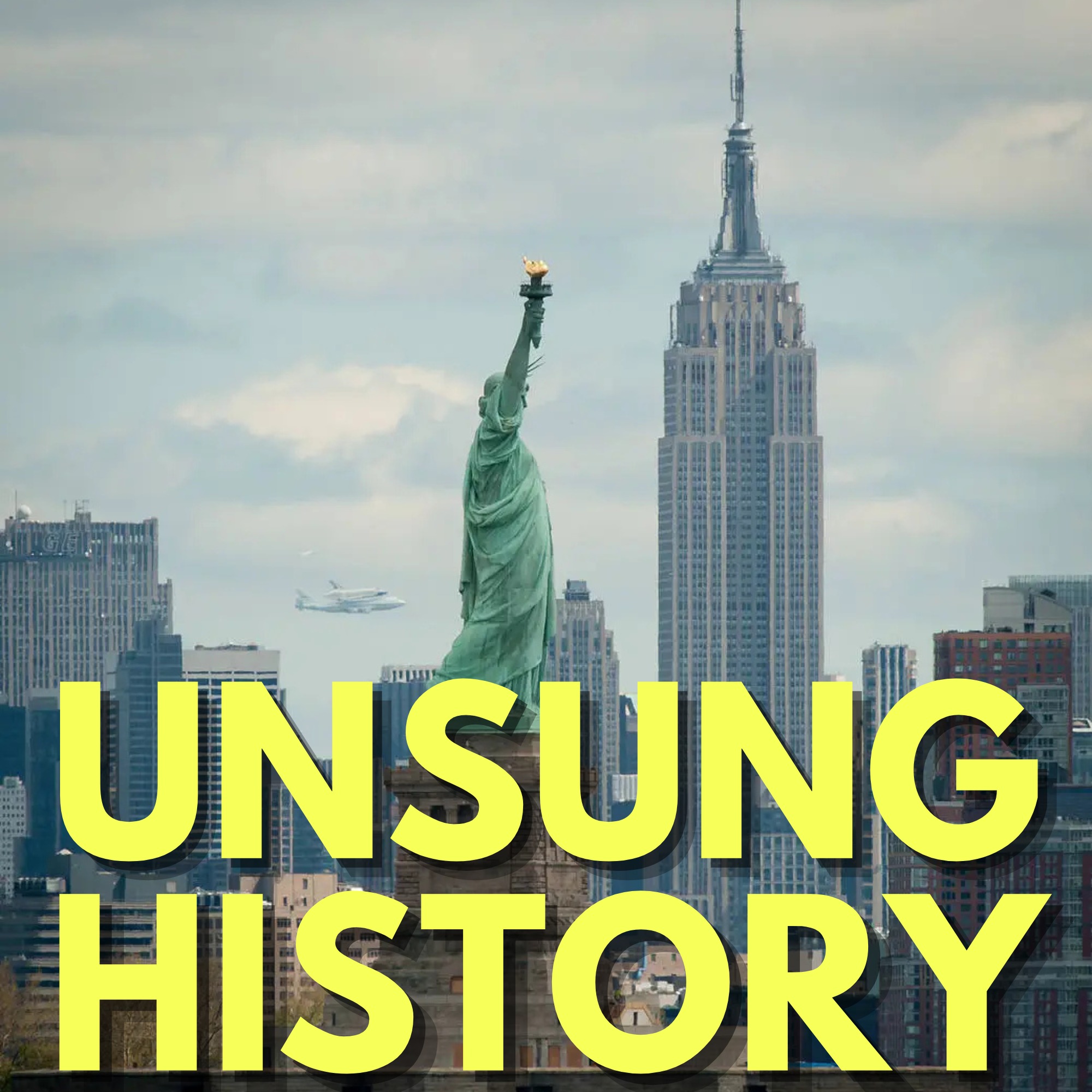


The Statue of Liberty and the Empire State Building loom large in the American imagination, symbolizing the conflicting ideas of liberty and empire; their meanings and characters have shifted over time as the American ethos has shifted. Joining me in this episode is writer, historian, and freelance editor, Dr. Vaneesa Cook, author of Empire and Liberty: The Tied Histories of Two American Landmarks.
Our theme song is “Frogs Legs Rag,” composed by James Scott and performed by Kevin MacLeod, licensed under Creative Commons. The mid-episode audio is “Hail to the spirit of liberty,” composed by John Philip Sousa and performed by Prince’s Orchestra in New York City on January 11, 1912; the audio is in the public domain and is available via the Library of Congress National Jukebox. The episode image is a photograph of NASA’s prototype space shuttle Enterprise, mounted atop a NASA 747 Shuttle Carrier Aircraft 905, during a flyover of New York City on Friday, April 27, 2012; the photographer was Bill Ingalls, and the government image is in the public domain.
Additional Sources:
- “Body of Iron, Soul of Fire: The Statue of Liberty,” by Jessie Kratz, National Archive Pieces of History, October 14, 2024.
- “Liberty Island Chronology,” Statue of Liberty, National Park Service.
- “Letter from Frédéric-Auguste Bartholdi (1834–1904) to his mother, June 24, 1871,” Frédéric-Auguste Bartholdi Papers, Manuscripts and Archives Division, New York Public Library.
- “Édouard Laboulaye and the Statue of Liberty: Forging the Democratic Experience,” by Stephen W. Sawyer, La lettre du Collège de France, 4, 2008-2009.
- “Gov. Alfred Emanuel Smith,” National Governors Association.
- “Oral history interviews with John J. Raskob family,” Hagley Digital Archives.
- “John J. Raskob Dies of a Heart Attack,” New York Times, October 16, 1950.
- “How the Empire State Building Was Built in Record Time,” by Tim Ott, History.com, Originally published October 10, 2024 and updated November 03, 2025.
Advertising Inquiries: https://redcircle.com/brands
00:00.111 --> 00:08.833
[SPEAKER_01]: This is Unsung History, the podcast where we discuss people and events in American history that haven't always received a lot of attention.
00:09.693 --> 00:11.794
[SPEAKER_01]: I'm your host, Kelly Theresa Pollock.
00:12.534 --> 00:19.436
[SPEAKER_01]: I'll start each episode with a brief introduction to the topic and then talk to someone who knows a lot more than I do.
00:20.556 --> 00:25.117
[SPEAKER_01]: Be sure to subscribe to Unsung History on your favorite podcasting app so you never
00:27.778 --> 00:32.820
[SPEAKER_01]: Tell your friends, family, neighbors, colleagues, maybe even strangers to listen to.
00:37.723 --> 00:48.347
[SPEAKER_01]: In June 1871, French sculptor Fredreca Gust Bartoldi arrived in New York City with his assistant Marie Simon.
00:49.508 --> 00:53.370
[SPEAKER_01]: Bartoldi was in the United States to raise funds for
00:56.760 --> 01:02.823
[SPEAKER_01]: a massive statue that he intended to build and gift the United States.
01:04.504 --> 01:18.892
[SPEAKER_01]: The project was called Liberty in Lightning the World, and Bartoldi and his friends in the French-American Union conceived of it as a token of the long friendship between France and the U.S.
01:20.824 --> 01:34.308
[SPEAKER_01]: French author and professor at Ward Renee Delablé, an abolitionist who was a deep admirer of the American Republic, had encouraged Bartoldy to travel to the U.S.
01:35.608 --> 01:42.010
[SPEAKER_01]: It was during a dinner party hosted by Lablé that the idea of the sculpture first arose.
01:43.559 --> 01:55.948
[SPEAKER_01]: During his five-month trip, Bartoldi met many prominent Americans, including President Grant, Senator Charles Sumner, Frederick Law Olmsted, and Brigham Young.
01:56.969 --> 02:09.038
[SPEAKER_01]: And he realized that American interest in the statue was greatest if he pitched it as part of a centennial celebration of the country, although he wouldn't actually make that deadline.
02:10.748 --> 02:18.890
[SPEAKER_01]: The French people began to contribute toward the cost of the statue, while the Americans fundraised for the pedestal.
02:20.430 --> 02:27.391
[SPEAKER_01]: The U.S. Congress voted in February 1877 to designate a site for the statue.
02:27.411 --> 02:35.833
[SPEAKER_01]: Unburts hold a strip, he had chosen Bedloes Island in Upper New York Bay, which was
02:39.188 --> 02:41.328
[SPEAKER_01]: and Congress agreed to the location.
02:43.249 --> 02:46.990
[SPEAKER_01]: In 1956, the island was renamed Liberty Island.
02:48.870 --> 03:04.373
[SPEAKER_01]: Even before Congress approved the site, or the funds were raised, Bartolli set to work, trying to figure out how to create the enormous statue, shaped like a woman with her right arm upraised holding a torch.
03:06.219 --> 03:20.664
[SPEAKER_01]: Labuelé had approved his plaster model and Bartoldi set to work, creating the hand and torch, which he then sent to the US for display at the Philadelphia Centennial Exhibition in 1876.
03:23.800 --> 03:43.892
[SPEAKER_01]: By toldy hired civil engineer, Alexandra Gustav Eiffel, who would later construct the Eiffel tower to devise the structure of the statue, which posed challenges because of the height and the weather elements it would face in New York Harbor, including wind.
03:45.113 --> 03:51.376
[SPEAKER_01]: Eiffel's solution was a massive inner framework of iron, over which the copper sheets
03:53.888 --> 04:00.409
[SPEAKER_01]: pedestal work began in the U.S. in 1885, but it stopped when they ran out of funds.
04:01.829 --> 04:09.991
[SPEAKER_01]: It was Joseph Pulitzer, publisher of The New York World, who ran a successful fundraising campaign to save the project.
04:11.771 --> 04:20.153
[SPEAKER_01]: Lady Liberty arrived in New York Harbor in pieces in 1885, but it was put in storage for a year
04:24.404 --> 04:33.775
[SPEAKER_01]: In 1886, with the pedestal finally finished, the pieces of the statue were reassembled by a majority immigrant workforce.
04:35.317 --> 04:43.947
[SPEAKER_01]: Finally, on October 28th, 1886, by a toldy formally unveiled liberty and lightning the world.
04:45.295 --> 04:56.184
[SPEAKER_01]: President Grover Cleveland accepted the gift on behalf of the United States, calling Bartolli, quote, the greatest man in America today, on vote.
04:57.945 --> 05:07.833
[SPEAKER_01]: A few decades later, two men, New Yorkers this time, instead of French, began to discuss a different kind of landmark project for the city.
05:09.114 --> 05:12.136
[SPEAKER_01]: Their discussion occurred not in a lovely
05:14.877 --> 05:17.018
[SPEAKER_01]: according to legend in a men's room.
05:18.539 --> 05:31.047
[SPEAKER_01]: According to actor Eddie Dowling, John J. Raskob, former head of finance for General Motors, approached former New York governor Al Smith at the Lodos Club's urinals.
05:32.387 --> 05:37.430
[SPEAKER_01]: Smith had recently lost the 1928 presidential election to Herbert Hoover,
05:43.017 --> 05:47.801
[SPEAKER_01]: Supposedly, Ras Cobb said to Smith, quote, don't worry, Al.
05:48.401 --> 05:55.727
[SPEAKER_01]: I'm going to build a new skyscraper, biggest in the world, and you're going to be president of the company, on vote.
05:57.528 --> 06:00.510
[SPEAKER_01]: Smith agreed to Ras Cobb's offer of a $50,000 a year salary.
06:03.403 --> 06:08.827
[SPEAKER_01]: And they got to work, planning for the largest building, not just in New York, but in the world.
06:09.747 --> 06:18.654
[SPEAKER_01]: Which meant, topping the recently completed Chrysler Building, which, with its silver spike, reached 1,046 feet.
06:20.395 --> 06:27.179
[SPEAKER_01]: Just two months after their building project was announced in 1929, the stock market crashed.
06:28.040 --> 06:30.562
[SPEAKER_01]: Triggering what would become the Great Depression.
06:32.039 --> 06:48.262
[SPEAKER_01]: Still, Raskeben Smith carried on with their plans, selecting a site at 5th Avenue in 34th Street, where the outdated Waldorf Astoria hotel was for sale, primed for demolition and redevelopment.
06:50.023 --> 06:56.284
[SPEAKER_01]: Rather than naming the building after himself, Raskeben chose a moniker that evoked New York
07:01.334 --> 07:06.320
[SPEAKER_01]: after George Washington's reference to New York as the seat of the empire.
07:08.062 --> 07:20.155
[SPEAKER_01]: As Smith explained, the building was, quote, intended to stimulate trade, commerce, and continue to make New York the imperial city of the world, unquote.
07:22.012 --> 07:26.996
[SPEAKER_01]: Smith as the public face of the project was a key piece of Rascob's vision.
07:28.217 --> 07:40.568
[SPEAKER_01]: Promotional materials described Smith as, quote, so well known to the public that his very presence placed the seal of integrity upon the undertaking, unquote.
07:42.203 --> 07:53.474
[SPEAKER_01]: The architectural plans were revised several times in a bid to ensure that the empire state building would remain the tallest building in the world.
07:55.275 --> 08:06.366
[SPEAKER_01]: Once they began work, the building was constructed quickly at a pace of four and a half floors per week, with a total timeline lasting just a year and 45 days.
08:08.960 --> 08:13.981
[SPEAKER_01]: Of course, Rascub and Smith didn't do that physical construction work themselves.
08:15.761 --> 08:30.724
[SPEAKER_01]: It took more than 3,000 workers to produce the building, including raising the 57,000 tons of steel making up the buildings frame, pouring 62,000 cubic yards of concrete, installing
08:38.514 --> 08:54.925
[SPEAKER_01]: On May 1st, 1931, President Herbert Hoover, Smith's rival for the presidency, pressed a button in the White House that turned on the lights of the Empire State Building in New York, symbolically opening the building.
08:56.426 --> 08:59.908
[SPEAKER_01]: It remains the world's tallest building at 102 stories and 1,250 feet
09:09.392 --> 09:20.822
[SPEAKER_01]: Around 3.5 million people visit the Statue of Liberty each year, which is now operated as part of the National Park Service, and is accessible only by ferry.
09:22.483 --> 09:28.288
[SPEAKER_01]: The observation deck of the Empire State Building sees about 4 million visitors per year.
09:30.041 --> 09:39.623
[SPEAKER_01]: The building is now owned and operated by a publicly traded real estate investment company, called the Empire State Realty Trust Incorporated.
09:40.883 --> 09:50.065
[SPEAKER_01]: And the building continues to operate as an office tower, housing over 1,000 companies, including LinkedIn, Shutterstock, and Workday.
09:51.826 --> 09:56.727
[SPEAKER_01]: Joining me in this episode is writer, historian, and freelance editor,
09:59.463 --> 10:06.249
[SPEAKER_01]: author of Empire and Liberty, the tide histories of two American landmarks.
10:26.812 --> 10:27.493
[SPEAKER_01]: Have a nice set.
10:27.513 --> 10:29.034
[SPEAKER_01]: Thanks so much for joining me today.
10:29.654 --> 10:30.275
[SPEAKER_01]: Thank you Kelly.
10:30.935 --> 10:33.958
[SPEAKER_01]: Yeah, I am looking forward to this conversation.
10:34.378 --> 10:36.100
[SPEAKER_01]: I want to start by asking a little bit.
10:36.120 --> 10:37.821
[SPEAKER_01]: This is I believe your second book.
10:37.941 --> 10:43.666
[SPEAKER_01]: So what got you started on this topic on thinking this would be a project you wanted to work on.
10:44.687 --> 10:49.971
[SPEAKER_02]: So the idea for this book stemmed from an incident that happened in the summer of 1945 and for.
10:52.471 --> 11:17.026
[SPEAKER_02]: Several years I kept on hearing reminisces about this incident, particularly on like this day in history, July 28th, they would talk about the day when a World War II pilot accidentally crashed his B-25 into the upper floors of the Empire State Building and what a huge disaster that was for the damage of the building and killing several people and how that was this
11:20.908 --> 11:33.282
[SPEAKER_02]: And whenever I heard that over the years, something inside of me told me there was a book there, and I wasn't quite sure how to delve into that topic or what kind of material I could extrapolate from that one incident.
11:33.703 --> 11:39.950
[SPEAKER_02]: So at first I intended to write a book about the history of the Empire State Building and include that anecdote in it.
11:40.450 --> 12:01.131
[SPEAKER_02]: But then I realized that there are already a couple of books written about that topic and and very well research So then I came up with the idea of oh well, there's the Empire State Building as a prominent landmark in New York City Also the Statue of Liberty is right there and we don't usually think about them in conversation with each other
12:02.307 --> 12:06.629
[SPEAKER_02]: And then I realized one of them represents or symbolizes empire.
12:06.649 --> 12:09.350
[SPEAKER_02]: The other symbolizes liberty.
12:09.971 --> 12:20.175
[SPEAKER_02]: And as a historian, I knew that narrative very well about how the United States has tried to reconcile empire and liberty throughout our history, the tensions between those two.
12:21.036 --> 12:28.719
[SPEAKER_02]: And so I already had that narrative to draw upon and we then to the story of the Empire State Building Statue of Liberty.
12:30.360 --> 12:47.889
[SPEAKER_02]: three different stories interwoven in this book, one about the conception, construction, and reception of the Empire State Building, same with the Statue of Liberty, the idea behind it, the construction are building of it, and then the unveiling in public interpretation of it.
12:48.649 --> 12:49.390
[SPEAKER_02]: But then also,
12:50.479 --> 12:56.085
[SPEAKER_02]: Throughout the chapters I talk about that history of trying to work out empire and liberty.
12:56.425 --> 13:05.015
[SPEAKER_02]: The United States has an expanding empire over the last 200 years and then also a nation dedicated to liberty and the debates about that.
13:05.987 --> 13:15.590
[SPEAKER_01]: So you, as you just mentioned, you're telling this kind of larger story of American history, how did you conceptualize putting this all together into a story?
13:15.630 --> 13:20.852
[SPEAKER_01]: What are the sources you drew on and how did you sort of figure out what that framework might look like?
13:22.005 --> 13:41.351
[SPEAKER_02]: Yeah, so I did read a research or a use for research some of those books and I mentioned that we're already written about the Empire State Building and Statue Liberty as a baseline to get just a sense of that history for each of the landmarks, but then I was very deliberately trying to tell the story through people.
13:41.971 --> 13:48.156
[SPEAKER_02]: because I didn't want it to be this cold, you know, architectural history of these two structures.
13:48.677 --> 13:53.961
[SPEAKER_02]: I wanted to bring in familiar names to appeal to a general audience, which the book does.
13:54.702 --> 14:03.109
[SPEAKER_02]: And so I found, I curated and included a lot of anecdotes and wrote them as vignettes throughout the book.
14:03.210 --> 14:08.414
[SPEAKER_02]: And so there are a lot of familiar names and some interesting, maybe little-known facts
14:09.555 --> 14:16.441
[SPEAKER_02]: familiar historical figures such as Henry Ford, Frank Bound, who was the author of the Wizard of Oz series Helen Keller.
14:16.821 --> 14:23.086
[SPEAKER_02]: We went to the top of the Empire State Building and even though she was deaf and blind, gave a very vivid description of her experience up there.
14:23.936 --> 14:35.061
[SPEAKER_02]: people like Jane Adams, Queen Elizabeth, presidents throughout US history from George Washington to Lincoln to FDR, JFK, they all feature prominently.
14:35.802 --> 14:44.946
[SPEAKER_02]: Donald Trump, not into his presidency, but he happened to be a partial owner of the Empire State Building in the 1990s, and there was a lot of controversy about that.
14:45.386 --> 14:55.131
[SPEAKER_02]: ownership and his approach to the ownership and so there's a lot of familiar names that will pop up as you're reading this and maybe you'll think about these people in a different way.
14:55.691 --> 14:58.873
[SPEAKER_02]: Also there's a lot of pop culture references with the two landmarks.
14:59.461 --> 15:05.627
[SPEAKER_02]: So the movie King Kong was very instrumental in bringing attention to the Empire State Building, that movie in the 1930s.
15:05.668 --> 15:10.833
[SPEAKER_02]: The movie Rocky other films that the two landmarks appear in.
15:11.434 --> 15:15.418
[SPEAKER_02]: And so that kind of exposure increased their visibility.
15:15.438 --> 15:17.400
[SPEAKER_02]: The public can help make them icons.
15:18.608 --> 15:40.295
[SPEAKER_01]: Let's talk then a little bit about the origins of the Statue of Liberty, so I think a lot of people probably think of it as this monument to immigration and that's of course not how it started out so can you talk some about what what the background of that looked like why the people who conceptualized created it did so.
15:41.328 --> 15:50.915
[SPEAKER_02]: Yeah, I think that I learned a lot or I realized a lot starting this research that I didn't know about the intention of the statute of liberty and where that idea got started.
15:50.976 --> 15:52.937
[SPEAKER_02]: So I assume that a lot of people don't know that.
15:53.598 --> 15:56.560
[SPEAKER_02]: It really started right at the end of the U.S. Civil War.
15:57.100 --> 16:01.764
[SPEAKER_02]: There were these French group of French Republicans who had always admired the U.S. Republican.
16:02.044 --> 16:07.688
[SPEAKER_02]: They were kind of jealous that the U.S. had this Republican, the French weren't able to make that happen.
16:07.708 --> 16:08.029
[SPEAKER_02]: They were
16:08.489 --> 16:30.075
[SPEAKER_02]: going through different waves of monarchies and dictatorships, so there was a group of French Republicans led by Edward Lobelai who, after the U.S. civil war, they were so relieved that the war had not destroyed the U.S. republic that held so much promise as an example for the rest of the world, and they were also very pleased that Liberty had been extended to
16:37.497 --> 16:53.920
[SPEAKER_02]: offer a gift to the United States particularly Lincoln he revered Lincoln and Lincoln had been assassinated but he sent something to Mary Todd and he wanted to send a gift statute to the United States and so he mentioned this in the company of young sculptor Frederick Bartolli.
16:54.687 --> 17:05.033
[SPEAKER_02]: Bartolty took a long time to pursue the idea in the United States and then also to construct it, and so it was decades a decades-long process.
17:05.573 --> 17:11.537
[SPEAKER_02]: During that process, the intention in the meaning behind the statue from Bartolty's perspective changed.
17:11.997 --> 17:13.858
[SPEAKER_02]: By the time that he finished it,
17:14.866 --> 17:20.112
[SPEAKER_02]: in the 1880s, it had been 20 years since the Civil War, and so that seemed passe.
17:20.712 --> 17:27.079
[SPEAKER_02]: But as he toured the United States, he realized that it was coming up on the Centennial celebration.
17:27.220 --> 17:29.883
[SPEAKER_02]: So he came here in the 1870s and realized that
17:30.383 --> 17:34.068
[SPEAKER_02]: Oh, there's this 1876 celebration that's imminent.
17:34.108 --> 17:42.638
[SPEAKER_02]: So maybe I can tie it to that and still celebrate the U.S. Republic, but more towards the independence in 1776.
17:42.998 --> 17:45.341
[SPEAKER_02]: And that's why I'm the tablet of the Statue of Liberty.
17:45.441 --> 17:47.764
[SPEAKER_02]: She does have that date on their 1776.
17:49.726 --> 18:04.186
[SPEAKER_02]: and many people might not know that there are broken chains under one of the feet of the statue, and that is the only reference left to that original intention of commemorating the emancipation of slaves in the end of the Civil War.
18:05.221 --> 18:11.945
[SPEAKER_01]: So then let's think about the Empire State Building and the background and construction of it.
18:12.225 --> 18:16.488
[SPEAKER_01]: And I hadn't realized that El Smith was part of that story.
18:16.568 --> 18:19.730
[SPEAKER_01]: So perhaps a little more straightforward of a story.
18:19.870 --> 18:20.971
[SPEAKER_01]: Why do you build a tall building?
18:20.991 --> 18:22.672
[SPEAKER_01]: Because you're building a tall building.
18:22.732 --> 18:24.673
[SPEAKER_01]: But what was the background of that?
18:25.213 --> 18:28.857
[SPEAKER_02]: Yeah, so that construction happened a lot faster.
18:28.917 --> 18:36.324
[SPEAKER_02]: It's 13 months, I think, a little over a year from opening day when they started the foundation and started construction.
18:36.785 --> 18:38.466
[SPEAKER_02]: And Al Smith was instrumental in that.
18:38.486 --> 18:42.911
[SPEAKER_02]: He had run for president and lost a Hoover and the former governor of New York.
18:43.491 --> 18:46.554
[SPEAKER_02]: You know, native son of New York needed something else to do.
18:46.674 --> 18:51.838
[SPEAKER_02]: So a wealthy financial guy named John Raskov came to him.
18:52.218 --> 18:54.420
[SPEAKER_02]: And they had been friends through the Democratic Party.
18:54.960 --> 19:01.485
[SPEAKER_02]: And Raskov said, hey, I have an idea to buy this parcel of land in New York City and build this huge skyscraper.
19:02.166 --> 19:03.787
[SPEAKER_02]: And I want you to help me promote it.
19:03.907 --> 19:06.289
[SPEAKER_02]: And so that's where that collaboration came from.
19:06.789 --> 19:10.672
[SPEAKER_02]: And Al Smith was very associated with the building from start to finish.
19:11.693 --> 19:35.359
[SPEAKER_02]: they did not make money they intended at first because even though the plans were being finalized at the end of the 1920s, the stock market crash and the Great Depression happened and so they weren't personally affected by it, but the building wanted to open in 1931 just didn't get the rental space from businesses that they were hoping for because of the tight times.
19:35.799 --> 19:40.800
[SPEAKER_02]: They did get some money from tourism from people wanting to go up to the observation deck, but that didn't make
19:41.520 --> 19:42.992
[SPEAKER_02]: until after World War Two.
19:44.537 --> 19:53.001
[SPEAKER_01]: Liberty Empire, both kind of complicated concepts and meaning changes a lot over time, especially for where liberty.
19:53.522 --> 19:54.582
[SPEAKER_01]: Let's start with liberty.
19:55.302 --> 20:02.146
[SPEAKER_01]: What did Bertoldy Lablay, what did they think of liberty like what was the meaning for them?
20:02.346 --> 20:11.991
[SPEAKER_01]: And then how does that shift over the course of, you know, it's now been over a century since then, what does that look like over time?
20:13.127 --> 20:30.842
[SPEAKER_02]: For them, for the French Republicans who gifted the statue, like L'Abley and Bartoldi, and that cohort, including descendants of Marquis Lafayette, the liberty was very much connected to Republican values, so Republicanism, which meant representative government from the people by the people.
20:31.542 --> 20:37.765
[SPEAKER_02]: And that is something that was very rare, even in the 1860s when they had this idea about the statue.
20:38.485 --> 20:49.090
[SPEAKER_02]: And so, because it was so rare in the United States was going through this experiment of trying to maintain a republic, that was very a drew their admiration.
20:49.968 --> 20:52.289
[SPEAKER_02]: They didn't, and I talked about this a little in the book.
20:52.309 --> 20:54.529
[SPEAKER_02]: They did make a distinction to democracy.
20:55.129 --> 21:04.731
[SPEAKER_02]: Full fledged democracy to them was a little bit dangerous because they were afraid it could develop into mob rule and they had seen that happen in 1789, for example.
21:05.172 --> 21:11.513
[SPEAKER_02]: And so they did think there should be this buffer of representatives in Congress or some other assembly.
21:11.993 --> 21:16.214
[SPEAKER_02]: But I think they did want it to be expanded to more people over time.
21:16.254 --> 21:18.415
[SPEAKER_02]: They realized that the United States didn't completely
21:20.175 --> 21:28.163
[SPEAKER_02]: Even after the emancipation of slaves, there was still women who did not have full citizenship rights, including the right to vote until 1920.
21:28.803 --> 21:37.051
[SPEAKER_02]: And so that was something that they hoped for that the Republican the United States will continue to expand those rights and live up to that promise.
21:37.792 --> 21:38.592
[SPEAKER_02]: Today, I think...
21:39.520 --> 21:40.460
[SPEAKER_02]: it's still similar.
21:40.480 --> 21:42.882
[SPEAKER_02]: I, you know, that kind of definition.
21:42.902 --> 21:49.945
[SPEAKER_02]: I think that more and more people are demanding those rights or fighting for them as minority groups and excluded groups.
21:50.745 --> 22:00.370
[SPEAKER_02]: And I think it's important to recognize that liberties once gained aren't secure forever that they can be pushed back and we're seeing that today.
22:00.470 --> 22:05.512
[SPEAKER_02]: So it's a constant struggle to demand liberty from powers that be.
22:07.087 --> 22:15.675
[SPEAKER_01]: Yeah, part of the story that's interesting here is the role of government in securing or limiting liberty.
22:15.695 --> 22:21.139
[SPEAKER_01]: I think that's especially clear as you're talking about FDR and the new deal.
22:21.159 --> 22:33.070
[SPEAKER_01]: And Al Smith, of course, who was a Democrat and, you know, had competed with FDR for the nomination, has a very different view of what the role of government should be.
22:33.110 --> 22:34.191
[SPEAKER_01]: Could you talk some about that?
22:34.998 --> 22:52.833
[SPEAKER_02]: Yeah, so there was some tension between Al Smith and his Democratic Party rival Franklin Roosevelt, especially when Roosevelt became president and the new deal really expanded a lot of executive power and Democratic power centralized at the top with all these programs that were being created by the federal government.
22:53.193 --> 23:03.141
[SPEAKER_02]: And so Al Smith did speak out and he actually paired up with a teamed up with Herbert Hoover in a lot of this criticism because Hoover has a Republican who believed in small government
23:03.886 --> 23:08.169
[SPEAKER_02]: didn't want that kind of centralized power from from the executive.
23:08.589 --> 23:12.071
[SPEAKER_02]: And so they did speak up against it the new deal in particular.
23:12.412 --> 23:25.300
[SPEAKER_02]: But there was also for Hoover at least an economic component to it that they believed that the government was controlling the economy too much and that they were afraid it was going toward socialism in that left-word direction too far.
23:25.920 --> 23:31.003
[SPEAKER_02]: So that was, I talked about that debate in itself about economic freedom for some people.
23:31.603 --> 23:46.332
[SPEAKER_02]: It can be all about the pursuit of your happiness and your wealth and that should be a part of freedom, but then there's the other end where you start to exploit people or countries for that money-making ability and that can impinge on the freedom of other people.
23:47.098 --> 24:05.565
[SPEAKER_01]: of course the occupants of the Empire State Building might be on that side of trying to make money and potentially exploiting people, you know, I think it's maybe people are starting to think more about this idea of American Empire, but of course America has typically tried to, you know,
24:09.626 --> 24:11.687
[SPEAKER_01]: Can you talk some about that?
24:11.947 --> 24:23.209
[SPEAKER_01]: What that means for the United States to throw out its entire history bin and empire, but yet try to present this view of it and not exactly being an empire.
24:24.070 --> 24:29.851
[SPEAKER_02]: Yeah, so that has a long history going back to the Revolutionary era and George Washington and Thomas Jefferson.
24:30.271 --> 24:33.312
[SPEAKER_02]: Thomas Jefferson coined the phrase empire of liberty to
24:33.972 --> 24:57.629
[SPEAKER_02]: label the United States as a special kind of empire that was yes we're expanding and taking over territory and increasing our power and influence but we also want to remain dedicated to liberty and so that's always been a very difficult straddle for the United States to reconcile those two things because they are by definition opposites the empire part you know is about
25:03.853 --> 25:05.354
[SPEAKER_02]: in foreign parts of the world.
25:06.035 --> 25:09.176
[SPEAKER_02]: And the Liberty part of course is about liberating people.
25:09.637 --> 25:15.240
[SPEAKER_02]: And so the Ice States has used that rhetoric of Liberty even while expanding as an empire, especially throughout the world.
25:15.740 --> 25:18.822
[SPEAKER_02]: After 1898, when it acquired colonies and became
25:19.482 --> 25:33.508
[SPEAKER_02]: for all intents and purposes in empire, but it still maintain that image of itself as liberty loving and trying to extend liberty to other people and that was often the rationale for, say, the Philippines taking over the Philippines.
25:33.568 --> 25:38.330
[SPEAKER_02]: Well, we don't want another empire to grab them and oppress them so we'll,
25:39.030 --> 25:42.833
[SPEAKER_02]: maintain this control over them and teach them self-government over time.
25:43.293 --> 25:51.259
[SPEAKER_02]: And so that's been a common refrain throughout US history of of saying that we're really just controlling them until they're capable of self-government.
25:51.719 --> 25:59.205
[SPEAKER_02]: But that can look very different to the people around the world who are under that control or being pressured to do with the United States demands.
25:59.625 --> 26:04.849
[SPEAKER_02]: And so it does tend to cause some resentment around the world that we see play out from time to time.
26:05.379 --> 26:20.510
[SPEAKER_01]: Yeah, it's interesting to see the types of empire building that the U.S. does as well, not always just going in and conquering, although that happens as well, but things like dollar diplomacy and good neighbors, what does that look like?
26:21.599 --> 26:27.802
[SPEAKER_02]: Yeah, so that's what's called the soft power and it has been employed by other traditional empires like Great Britain or Spain.
26:27.882 --> 26:37.987
[SPEAKER_02]: So it's not completely new, but the United States really ran with that idea as a way to convince itself and everyone else that it was still liberty loving.
26:38.307 --> 26:39.928
[SPEAKER_02]: The thought was that as long as we're not
26:40.348 --> 27:00.668
[SPEAKER_02]: We don't have boots on the ground or, you know, a formal colonial relationship with these, with, with countries, then it's not technically imperialistic, but if you're pressuring countries with guns and a military invasion or your offering money incentives that they can't really say no to.
27:01.208 --> 27:10.254
[SPEAKER_02]: That's another form of empire that's a little bit softer, but it's more threatening, but it's still the U.S. way of doing empire.
27:10.614 --> 27:12.856
[SPEAKER_02]: Really took advantage of those techniques.
27:14.097 --> 27:23.463
[SPEAKER_01]: So we mentioned that at the beginning of its existence, the Statue of Liberty was not about immigration, but it of course develops this over time.
27:23.523 --> 27:24.744
[SPEAKER_01]: How does that happen?
27:25.933 --> 27:39.599
[SPEAKER_02]: So, on the opening day in October 1886, there were some passing references it wasn't, I would say a focus of the speeches that day, even though Steam ships apparently were coming in through the harbor as the ceremony was going on.
27:40.120 --> 27:47.903
[SPEAKER_02]: I think at least one speaker made a passing reference to the statue welcoming newcomers to the United States, and then the next day there were
27:51.505 --> 28:03.855
[SPEAKER_02]: saying that, you know, there's this new statue with her, her torch a loft welcoming in hopefuls to the United States who wanted to build a better life and enjoy more freedoms in this country.
28:03.955 --> 28:12.763
[SPEAKER_02]: So, but Bartoldi from that beginning he pushed against that a little bit, he really wanted this as a very general
28:13.283 --> 28:23.474
[SPEAKER_02]: celebration of the Republic, the U.S. Republican values, and so he didn't want it to be pigeonholed into immigration specifically.
28:24.015 --> 28:32.184
[SPEAKER_02]: But that reference point became more prominent after Ellis Island opened in the early 1900s, so Ellis Island was not
28:32.724 --> 28:47.608
[SPEAKER_02]: there as a processing center for immigrants when the Statue of Liberty was unveiled, but once it was and immigrants were being, were entering the United States through Dallas Island, very close to Liberty Island that connection became more clear.
28:48.049 --> 28:52.390
[SPEAKER_02]: And then also in the late 1800s, you know, immigrants
28:53.210 --> 29:13.835
[SPEAKER_02]: future immigrants would hear their family members who had already gone to the United States right letters home and say, when you come look for the statue of Liberty and so they really did look forward to that and got emotional when they saw the statue of Liberty and very often used the statue as a reminder not to take Liberty for granted and to feel so lucky to be in the United States.
29:15.000 --> 29:26.995
[SPEAKER_01]: You're right, throughout the book of the Statue of Liberty as a place of protest as well, including from literally its opening day, what are the kinds of protests that people are doing?
29:27.075 --> 29:29.659
[SPEAKER_01]: Why are they choosing to do it in this place?
29:30.720 --> 29:46.392
[SPEAKER_02]: Yeah, that was one of the surprising things that when I was researching, I didn't realize how many protests had either happened at the Statue Liberty site or that it was used as a former protest with, you know, referring to it and writing a newspaper editorials or whatnot.
29:47.112 --> 29:54.839
[SPEAKER_02]: So from the very first day, as you said, there were a contingent of women from the New York State suffrage association.
29:55.500 --> 30:07.231
[SPEAKER_02]: They rented a barge and had protest signs and a bullhorn, you know, criticizing the Statue of Liberty that was in the form of a woman and yet women couldn't even vote yet and had limited rights.
30:07.631 --> 30:11.074
[SPEAKER_02]: And so they really highlighted that hypocrisy of the United States.
30:11.935 --> 30:28.284
[SPEAKER_02]: And women really weren't even allowed on Liberty, it was Bedlow Island at that point, but on the island during the ceremony, except for the two wives of the French dignitaries who were there, including Bartolli, but otherwise women did not have access to the island.
30:28.565 --> 30:34.048
[SPEAKER_02]: They did not have access to the banquet dinners afterwards, so there was very clear exclusion
30:39.891 --> 30:58.717
[SPEAKER_02]: But, you know, other minority groups as well, called it a sham or referred to it as hypocrisy, Asian Americans who were mistreated in the country, black Americans, there were items in newspapers calling out the Statue of Liberty for symbolizing unfulfilled promises.
30:59.577 --> 31:18.002
[SPEAKER_02]: W. E. B. Duboy, the famous black intellectual noted how when he came back from Europe and saw the statue of Liberty on one trip, he said, you know, isn't it ironic that she has her back toward America and the problems of race that are still such an issue here for limiting liberty?
31:18.682 --> 31:42.471
[SPEAKER_02]: So it was women, black Americans, Asian Americans, but then it was also used as a protest site for people who had issues with Vietnam War, so the veterans against the Vietnam War in the late 60s, early 70s, at one point they occupied the island for two days, as a former protest to get attention for calling for peace in Vietnam.
31:43.682 --> 31:49.444
[SPEAKER_02]: even Iranian, pro-Iranian, Shaw students in the United States, they occupied the island.
31:49.924 --> 31:55.465
[SPEAKER_02]: But then it's also been ubiquitous in political commentary and political cartoons.
31:55.965 --> 32:05.368
[SPEAKER_02]: So I do reference examples of that throughout the years where liberty is often drawn into cartoons to show how liberties are being violated.
32:06.656 --> 32:19.720
[SPEAKER_01]: Yeah, and of course the Empire State Building is in lots of popular culture, the image is used a lot, but interestingly, often not refer to Empire, but actually very romantic ideals.
32:20.160 --> 32:28.623
[SPEAKER_01]: Literally romantic ideals when people are like meeting on the top of the Empire State Building into you have explanation for why that might be.
32:29.872 --> 32:34.337
[SPEAKER_02]: Yeah, that was another interesting reality that I picked up on.
32:34.397 --> 32:47.452
[SPEAKER_02]: In fact, when I was first talking about the book to some friends and scholarly colleagues and explaining the premise of the book, and I said, you know how the Empire State Building symbolizes Empire and they gave me a quizzical look and they were like, really?
32:48.912 --> 33:14.457
[SPEAKER_02]: It represents Empire, and I was like, well, it's in the name, first of all, but I guess it kind of surprised me that people no longer associate the Empire state building with that concept of Empire when it was so clearly the intention of the builders and the promoters of the building in the 1930s and you'll read the rhetoric in the book that, you know, Al Smith definitely put it in those terms that this is a simple to economic power in the United States
33:17.304 --> 33:19.005
[SPEAKER_02]: in New York at being the hub of that.
33:19.845 --> 33:36.312
[SPEAKER_02]: I guess it lost some of that over time became more romanticized especially because of its architectural beauty and you know it's prominence in the skyline of New York as a landmark and then movies incorporated into their love stories as
33:37.412 --> 33:51.352
[SPEAKER_02]: As you mentioned, so you have an affair to remember with Carrie Gran in Debra Carr, and then, of course, sleepless in Seattle, you know, doubles down on that in the 1990s and referred to earlier movie and meaning at the top of the Empire state building.
33:52.273 --> 34:06.776
[SPEAKER_02]: I think it took on a more romanticized and even innocent image over the decades, and that is also amplified by the construction of bigger skyscrapers, including the Twin Towers, when they were opened in the early 1970s.
34:07.257 --> 34:15.138
[SPEAKER_02]: That was, those towers were absolutely dedicated to economic power and extending U.S. influence around the world.
34:15.759 --> 34:17.319
[SPEAKER_02]: And so I think that
34:18.019 --> 34:38.910
[SPEAKER_02]: symbolism shifted from the Empire State Building to the World Trade Center towers and they became used in films about economic greed or Wall Street or whatever and so that those towers took on that meaning and they became the bigger skyscrapers in New York City so I think that helps explain it.
34:40.180 --> 34:45.724
[SPEAKER_01]: I don't know, switch gears for just a minute and ask you, you also do editing and indexing.
34:45.964 --> 34:57.371
[SPEAKER_01]: And I would love to hear a little bit about indexing and how, like, it feels like it must involve so many choices and decisions on what's important, what's not.
34:57.431 --> 34:59.653
[SPEAKER_01]: So what if you could just talk about that for a little bit?
35:00.113 --> 35:01.174
[SPEAKER_02]: Yeah, thanks for bringing it up.
35:01.474 --> 35:04.876
[SPEAKER_02]: I do have my own freelance editing and indexing business.
35:04.956 --> 35:06.277
[SPEAKER_02]: It's called scholarship.
35:06.717 --> 35:09.519
[SPEAKER_02]: And I've been doing it since I graduated from grad school,
35:10.050 --> 35:29.837
[SPEAKER_02]: I graduated a little over eight years ago with the businesses eight years and I do index my own book so I did index the empire and liberty books so if you're flipping through and using the index you can see my work that way too when I do it for variety of clients academic clients mostly historians but a variety of topics and it is
35:31.097 --> 35:48.080
[SPEAKER_02]: A lot of people I think think of it as a very boring kind of accounting type of, you know, just inputting entries in the page number, and that is certainly part of it, but it's also creative because you have to figure the book out and you have to figure out how to organize the terms and the people.
35:48.580 --> 35:54.324
[SPEAKER_02]: You have to know which people or terms are going to be mentioned so much that you have to sub-categorize them.
35:55.024 --> 35:59.367
[SPEAKER_02]: And so that's always a fun task of trying to figure that out.
35:59.907 --> 36:12.795
[SPEAKER_02]: So yeah, it does involve a lot of decisions about how to organize the entries, which ones need sub-entries and cross-referencing, and all that kind of thing to make it as user-friendly as possible.
36:14.280 --> 36:17.010
[SPEAKER_01]: Empire in Liberty is a fascinating book.
36:17.231 --> 36:19.078
[SPEAKER_01]: Can you tell listeners how they can get a copy?
36:20.138 --> 36:28.822
[SPEAKER_02]: Yes, it's available through most online booksellers, including Amazon, Walmart, other online formats and websites like that.
36:29.242 --> 36:34.224
[SPEAKER_02]: Check your local bookstore if they don't have it, please ask for them to stock some copies.
36:35.024 --> 36:40.827
[SPEAKER_02]: And also libraries, if your local library doesn't have it, please ask them to purchase a copy.
36:41.287 --> 36:46.269
[SPEAKER_02]: And then also from the Beacon Press webpage in particular, that's the publisher, so you
36:48.705 --> 36:51.188
[SPEAKER_01]: is there anything else you wanted to make sure we talk about?
36:52.029 --> 37:03.941
[SPEAKER_02]: I guess the takeaway that I'd like readers to think about when they read this book is again, thinking of the United States as an empire which as you mentioned isn't usually the way we
37:09.180 --> 37:13.882
[SPEAKER_02]: You know, empires are nothing new or special in the history of the world.
37:14.002 --> 37:14.962
[SPEAKER_02]: They've come and gone.
37:15.322 --> 37:18.283
[SPEAKER_02]: The strong militaries aren't anything unique or special.
37:18.323 --> 37:24.785
[SPEAKER_02]: They have also come and gone, but the liberty part, I think, is what makes the United States special.
37:25.005 --> 37:28.347
[SPEAKER_02]: And it's what has earned the admiration of the world.
37:28.767 --> 37:31.708
[SPEAKER_02]: Even if it's imperfect, which it is, it's still...
37:32.548 --> 37:42.434
[SPEAKER_02]: draws attention from the world and the hope of the world that it will continue because almost everybody wants liberty and freedom and they want that from their government in their nation as well.
37:43.434 --> 37:52.059
[SPEAKER_02]: And so, you know, think of the U.S. as an empire but what really makes it unique and special is the dedication to liberty and that ongoing struggle.
37:52.079 --> 37:57.382
[SPEAKER_01]: If any setting you so much for speaking with me today, thank you very much.
38:14.655 --> 38:16.536
[SPEAKER_00]: Thanks for listening to UnSung History.
38:17.296 --> 38:20.817
[SPEAKER_00]: Please subscribe to UnSung History on your favorite podcasting app.
38:21.297 --> 38:26.779
[SPEAKER_00]: You can find the sources used for this episode in a full episode transcript at UnSung History Podcast.com.
38:27.399 --> 38:33.482
[SPEAKER_00]: To the best of our knowledge, all audio and images used by UnSung History are in the public domain or are used with permission.
38:34.302 --> 38:40.664
[SPEAKER_00]: You can find us on Instagram at UnSung Under Score Under Score History or on Facebook at UnSung History Podcast.
38:41.241 --> 38:47.921
[SPEAKER_00]: To contact us with questions, corrections, praise, or episodes suggestions, please email Kelley at unsignedhistorypockets.com.
38:48.643 --> 38:52.615
[SPEAKER_00]: If you enjoyed this podcast, please rate, review, and tell everyone you know.
38:52.976 --> 38:53.197
[SPEAKER_00]: Bye!
