


The Academy Awards
 Amazon Music Amazon Music
  Apple Podcasts Apple Podcasts
  Castbox Castbox
  Castro Castro
  Deezer Deezer
  Goodpods Goodpods
  iHeartRadio iHeartRadio
  Overcast Overcast
  Pandora Pandora
  PocketCasts PocketCasts
  Podcast Addict Podcast Addict
  Podchaser Podchaser
  RSS Feed RSS Feed
  Spotify Spotify
  TuneIn TuneIn
  YouTube YouTube
 When the Academy of Motion Picture Arts and Sciences was formed in 1927 one of the goals of the founders was to recognize achievements in the industry. That recognition quickly took the form of annual awards banquets, with the first one hosted in 1929. Over time the format shifted from banquet to the Oscars telecast we all know today, as the categories and even membership of the Academy adapted to the shifts in filmmaking. Joining me in this episode is Dr. Monica Sandler, a film and media historian at Ball State University, whose forthcoming book is The Oscar Industry: Creative Labor, Cultural Production, and the Awards System in Media Industry.
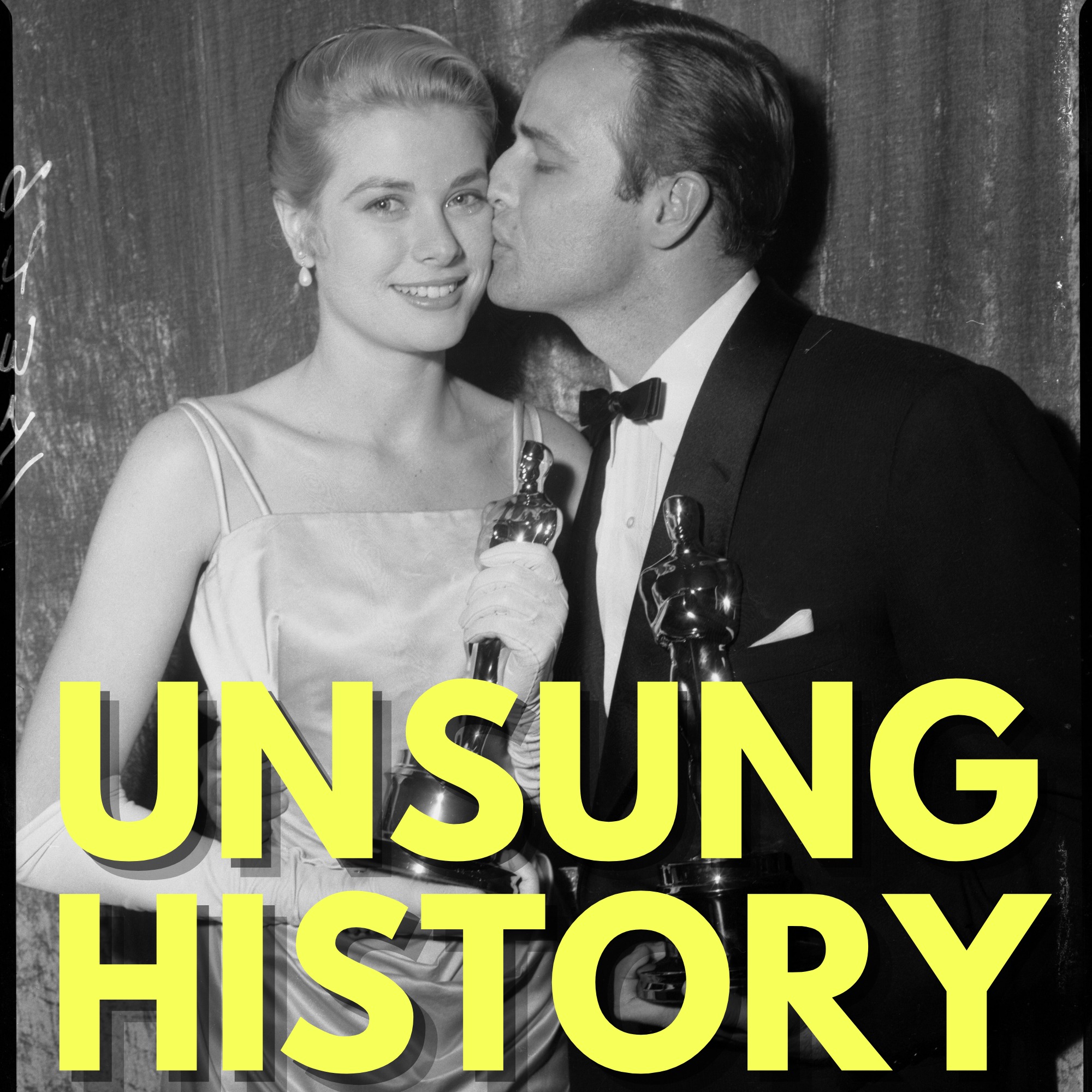
Our theme song is “Frogs Legs Rag,” composed by James Scott and performed by Kevin MacLeod, licensed under Creative Commons. The mid-episode music is “He’s working in the movies now,” composed by Henry Lodge, with lyrics by Harry Williams and Vincent Bryan; the song was performed by Billy Murray on February 27, 1914, in Camden, New Jersey; it’s in the public domain and is available via the Library of Congress National Jukebox. The episode image is of Grace Kelly and Marlon Brando at the Academy Awards on March 30, 1955, published in the Los Angeles Times on March 31, 1955; the copyright is held by the UCLA Charles E. Young Research Library Department of Special Collections, and this work is licensed under a "Creative Commons BY Attribution 4.0 International" .
Sources:
- “Experience over nine decades of the Oscars from 1927 to 2026,” Oscars.org.
- “Why Are the Academy Awards Called ‘Oscars’?” by Elizabeth Nix, History.com, January 22, 2026.
- “The Academy of Motion Picture Arts and Sciences [Pamphlet],” June 20, 1927, Available via the Margaret Herrick Library Digital Collections.
- “The Academy Awards Scandal That First Got PwC Its Job Counting Oscars Votes,” by Olivia B. Waxman, Time Magazine, March 2, 2018.
- “How Television Changed the Oscars,” by Lily Rothman, Time Magazine, February 22, 2015.
- ““TV – That’s Where Movies Go When They Die”: Rewatching the First Televised Oscars,” by Thomas Doherty, The Hollywood Reporter, March 26, 2022.
- “What Determines Whether a Performance Is Lead or Supporting? Oscar Rules Explained,” by Eliza Thompson, US Weekly, March 7, 2024.
Kelly Therese Pollock 0:00
This is Unsung History, the podcast where we discuss people and events in American history that haven't always received a lot of attention. I'm your host, Kelly Therese Pollock. I'll start each episode with a brief introduction to the topic, and then talk to someone who knows a lot more than I do. Be sure to subscribe to Unsung History on your favorite podcasting app so you never miss an episode, and please tell your friends, family, neighbors, colleagues, maybe even strangers, to listen too. On May 4, 1927, the Academy of Motion Picture Arts and Sciences was incorporated as a nonprofit organization in California. Actor Douglas Fairbanks, Sr. was its first president. Fairbanks' wife, actress Mary Pickford, was one of only three women to make up the group of 36 founding members. The other two were writers, Bess Meredyth and Jeanie MacPherson. At its inception, the Academy had five branches: producers, actors, directors, writers, and technicians. Among the Academy's stated goals was to recognize excellence in the field. They wrote in a founding pamphlet that the Academy, "will encourage the improvement and advancement of the arts and sciences of the profession by the interchange of constructive ideas and by awards of merit for distinctive achievements." To accomplish this goal, the Academy began an annual awards presentation. The first Academy Awards, honoring achievements in film for the 1927 to 1928 period, was held at a private dinner for around 270 people in the Blossom Room of the Hollywood Roosevelt Hotel on Thursday, May 16, 1929. Unlike today's suspense filled moments as the presenter opens the sealed envelope, at the first ceremony, the winners were announced to the media for publication in advance. Throughout the 1930s, newspapers received the winners in advance, but were instructed to wait until 11pm the night of the ceremony to publish. In 1940, though, the Los Angeles Times revealed the winners before the ceremony even began. In 1934, Bette Davis starred in an RKO film, "Of Human Bondage." Life Magazine later described Davis's acting turn as, "probably the best performance ever recorded on the screen by a US actress," but she was not nominated for an Academy Award, leading to rumors that the producers had interfered with the vote. Davis had been on loan to RKO from Warner, which wasn't thrilled to have its star shine for another studio. Whether or not there had been any interference, the uproar led to the Academy bringing in Price Waterhouse, now called PwC, to count the votes each year. After the 1940 LA Times leak, the presenters were handed sealed envelopes with the winners listed within. From that first award ceremony, winners of major awards have received a statuette of a knight standing on a reel of film holding a crusader's sword. The statuette was designed by Art Director Cedric Gibbons, who would himself go on to win the Academy Award for Best Art Design 11 times. Los Angeles sculptor George Stanley brought Gibbons's vision into three dimensions. Officially, that statuette is named the Academy Award of Merit, though today, most people call it the Oscar. The nickname wasn't formally adopted by the Academy until 1939, but it was in use by the mid 1930s. Legend has it that Academy librarian Margaret Herrick, who had later become the executive director, upon seeing the statuette for the first time, quipped that it looked like her Uncle Oscar. Today, the Oscar statuette is 13 and a half inches tall and weighs eight and a half pounds. The hefty weight comes from the metal. It's solid bronze with 24 karat gold plating. During World War II, metal shortages meant that for three years, the Oscars were made of painted plaster. After the war, winners were allowed to come back and trade in their plaster Oscar for a metal one. In 1953, the 25th Academy Awards was televised with Bob Hope as presenter. Previously, the award show had been broadcast over radio, and there was some resistance among people in the film industry to broadcasting on TV, for fear that it would legitimize the small screen. As Bob Hope joked during the ceremony, "TV? That's where movies go when they die." Reviewers at the New York Times and Billboard found the telecast boring, with Billboard complaining about the, "long stretch of ennui-inducing programming," but audiences tuned in. Trend X estimated the award show to have had 50 million viewers. The Academy may have been hesitant to televise their ceremony, but television has accepted it, with the annual Academy Awards telecast, winning over 60 Emmys, especially in technical and creative arts categories. Today, the Academy Awards has 24 competitive categories. At the first ceremony in 1929, there were 12 competitive categories: actor, actress, art direction, cinematography, directing of a comedy picture, directing of a dramatic picture, engineering effects, outstanding picture, unique and artistic picture, writing adaptation, writing original story, and writing title writing. It was the only time that Title Card Writing was recognized since the silent era was on its way out. Joseph Farnham won the award, though not for a specific film. In the acting categories at that first award show, the winners could be recognized for more than one film during the stated time period. For instance, the best actress winner, Jeanette Gaynor, won for three performances in 1927 and 1928: "7th Heaven," "Street Angel," and "Sunrise." At the ninth Academy Awards presented in 1937, the categories of Actor in a Supporting Role and Actress in a Supporting Role were introduced. It's up to the voters to determine whether a role is lead or supporting. At the 17th Academy Awards, actor Barry Fitzgerald was nominated for both Best Actor and Best Supporting Actor for the same role, Father Fitzgibbon. He won for supporting actor, and after that, the academy changed the rules to prevent such a situation from occurring again. At the 12th Academy Awards, presented in 1940, Hattie McDaniel won Best Supporting Actress for her portrayal as Mammy in "Gone with the Wind." It was the first win by an African American, and McDaniel was relegated to a segregated table at the ceremony. Sidney Poitier won the first lead acting role by an African American for his portrayal of Homer Smith in "Lilies of the Field" in 1964. It wouldn't be until 2002, at the 74th Academy Awards, that a Black woman would win a Best Actress Award, when Halle Berry won for her role as Leticia Musgrove in "Monster's Ball." At the 98th Academy Awards in 2026, a new category will be introduced for the first time in 25 years, that of achievement in casting. The most recent category introduced before that was Best Animated Feature in 2001.
Kelly Therese Pollock 9:59
Joining me in this episode Is Dr. Monica Sandler, a film and media historian at Ball State University, whose forthcoming book is, "The Oscar Industry: Creative Labor, Cultural Production, and the Awards System in Media Industry."
Kelly Therese Pollock 10:41
Hi, Monica. Thanks so much for joining me today.
Dr. Monica Sandler 10:45
Thank you for having me. Excited to be here.
Kelly Therese Pollock 10:48
I would love to hear how you first got interested in the Oscars and decided to write first a dissertation and then a book on the topic.
Dr. Monica Sandler 10:59
So if you asked me in high school, someday you're going to write a book, what is it going to be about? I know it would have, I would have said the Academy Awards. I've been, like, weirdly into them since I was quite young. So I can at least start off with that front like this has been a like, lifelong passion of mine. The big thing was, just growing up, my parents had an Entertainment Weekly subscription, and they had, like, awards punditry, and that was kind of my entry point into words. I could, I could read a bunch of punditry and statistics, and I could beat everyone in terms of predicting who was going to win, even when, like, at that point, some of the films I was too young to have seen, but it was like, no, no, no, this film is gonna win. Like, what are you talking about? You haven't seen this movie. It doesn't matter. That's what's gonna win. So that was really what kind of drew me into that. What brought me to doing the wider project overall, was I worked in in the film industry for a while, and was considering going back, and I had always been just deeply interested in the Oscars. And I just started reviewing, like, what body of literature existed around Academy Award history? And there are dozens, an uncountable number of non academic texts that exist on the Oscars, and there is very, very little body of literature in academic work. And my kind of response with that was, I can write this? I can do what? Oh my gosh. That was sort of what fueled me going back for my PhD. was, like, I'd always been interested, but I didn't, I wanted to have a project or, like, a reason for why I was doing it, and I found it in the thing I'd most loved for as long as I could remember at that point. So that was really like, how, how I became the Oscar lady. I, when have I not been, is kind of the vibe.
Kelly Therese Pollock 13:01
What does the research in this look like? Like, what are the kinds of archives and sources that you can draw on to understand more about the history of the Oscars?
Dr. Monica Sandler 13:11
So the big thing that came about for this project and with my dissertation, when I did my PhD at UCLA. While I was there, I spent most of my time at the Academy Herrick Library, and I was actually able to secure internal documents which were previously classified, and got the opportunity to look at all of them. And so I'm looking at it this abundance and wealth of research, where I'm not only seeing what happened, but why. What were the actual conversations in the room that are according to the meeting routes that like led to this policy that is really, really important and really impactful? What was really wonderful about it, this was a year, basically a year of my life, when I was doing my doctorate, was I was I lived down the street from the Herrick Library in Los Angeles. I was going there almost every day, and I had what I referred to as my magic box, which was that I gave the archivist, sort of a list of things, and most of them had not ever gone through any of these materials, either. So they were looking for folds and files that looked like on par with what I had. So the magic box was basically they would fill it with folders that they found that were on a subject that seemed related to what I was doing based off of what I'd given them. And then when it would get low, I'd sort of mention it, and then they would refill it. And would refill it. I had no idea what was going to be in it at that point. I also, like the scope of the project is decades. So I'm looking at something from 1927 and then the next thing is 1953 and it just sort of, I don't know what I'm working on right now. I'll just find out what's in the box, basically. And it one of the best years of my life, honestly.
Kelly Therese Pollock 14:44
Let's talk then about how the Oscars began and the Academy Awards began pretty quickly after the Academy itself began. So what does that look like at the beginning? What's the purpose? What are they actually trying to do? I'm sure it looked very, very different than it does now.
Dr. Monica Sandler 15:01
Yes. So the Academy Awards start in 1929. The founding of the Academy is in 1927. The idea for the Academy Awards are present like in the when they're brainstorming the idea for the organization, and they sort of have just kind of logistical challenges for a little a period of time of like, these people joined a committee and like, what are their scheduling conflicts? And oh, no one seems to be around right now. They're filming something, so it is always kind of present, but people are doing other things and sort of distracted. They get really serious about it in 1928 and like, that's when they finally kind of hunker down and create the first awards, but there's still this sort of two year lull between the founding and the Oscars. And the first Oscars are celebrating work from 1927 to 1928 in 1929, which feels really, really dated, actually, as it's happening. Notably, 1927 versus 1929 in Hollywood, there was the transition to sound. So they're celebrating a bunch of silent films when everyone was watching talkies. So there's definitely like this, is there a cultural relevance early on, and that takes a little bit of time to actually come into play within you know, what's actually, actually happening at the ceremony. But the first ceremony looked rather different from what we have. They had two best picture categories, which was a Best Artistic Film and then Best Picture, which is sort of what we think about today. They also kind of divided film up into different like, what qualifies as artistic versus what qualifies as just a regular Best Picture? But I think some of this is like we think about, like, what does Hollywood do? You know, big blockbustery type films fell a little bit more into the Best Picture category. A film called "Wings," which has these really incredible aerial shots that kind of revolutionized filming. It's about sort of air pilots during World War I, and so you have these great like action sequences in it that no one had ever done before. So that is you know, Hollywood doing what Hollywood does best. And then on the other side, you had "Sunrise" won Best Picture, which is generally thought of, I would say, from that period the FW Murnau renowned movie, kind of in the grand silent era films. It's usually on that list fairly high. So if we're looking back on a canon, like the artistic film, maybe has stood the test of time in history a little bit more, but not necessarily what's actually happened there. So that was what the like the stage of the first awards. And certainly there's, you know, why did they think this was a useful organization for that, of course, on top of everything else.
Kelly Therese Pollock 17:39
And who was the Academy? Like, who was actually deciding to do this, coming together? Who was voting on the the awards?
Dr. Monica Sandler 17:49
Yeah, so the Academy is developed as an idea. It has this mythic, like most of Hollywood, it has, it has a mythology that it started at a dinner at Louis B. Mayer's house, where he was talking to Fred Niblo and Conrad Nagel, who were an actor and director that he worked with regularly, and said, "You know, we've had all these problems in the industry, and what we really need to do is to sit down in a room and we should have, like, a League of Nations for the industry." That's how it was pitched, particularly in this context. Mayer really meant this in the context of, like, what if we had this where we just sat and negotiated things in a room instead of unionizing, was what he's really referring to. The first iteration of the Academy was kind of best seen as a fake union, where there were branches. Most of the lower division work for successfully unionized into IATSE in 1926, and then in 1927 is when the Academy is founded, and they're particularly serving actors, writers and directors who have not successfully organized into a union at this point. So there are groups like Actors Equity that are around and sort of lurking and would really like to organize people together and, like, help them secure bargaining rights for themselves. So the Academy is sort of pitched as an alternative, but there are a lot of very inherent contradictions. You asked about, like, who is in the Academy? Like, today, they were an honorary organization, so you it was by invitation only membership, so you have the so called best, I'm using quotation marks as I say that, so that you have the best of the industry that are invited. You have to have other members invite you into the organization and they're who ultimately vote on the Oscars. But they're also in the context of this is a fake union. They're the people who are negotiating over like, wage rights with producers, and none of them are working at standard wage in that context which their labor division fails by 1933 which is when the Screen Actors Guild and the Writers Guild organize. And you can kind of see some of the issues that may have already been at play almost immediately, but that continues on with what we think about with the Oscars too.
Kelly Therese Pollock 20:01
I mean, I assume that if you have to be invited by a current member, that it basically just keeps replicating itself, then at least for a while. But like the type of people who are in the Academy and who are voting.
Dr. Monica Sandler 20:15
Yes, definitely. Well, I think a really good example of this early on was that it tended to be at the Big Five studios, and Frank Capra in particular, who has ended up being president from 1935 to 1939, he talks about, like, adamantly petitioning because he was at Columbia and that he that the Academy didn't have basically any members that were from their production company. So he had to go through a petition process, basically complaining about this. So you literally have, you know, people at a very specific just even set of companies early on that are dominating.
Kelly Therese Pollock 20:51
What effect then does that have on things like race and sex and even you mentioned studio, but like studio versus independents. Like, what does that actually look like in the early years? And then, you know, how do they get sort of out of that, at least to a little bit of an extent?
Dr. Monica Sandler 21:08
Yeah, I mean in terms of representation for like, people of color, it's basically non existent in the earliest version of the Academy. The first person of color nominated for an Oscar was Merle Oberon, who was passing as white. She was of Indian descent, and that was in 1935. The first person of color invited to the membership was James Wong Howe, who was a cinematographer. The Academy, I always say replicates or is a further extension of an industry, an incredibly exclusionary industry, and then you have a snippet of a small group of people within the context of that, which makes it even more extreme. But I think you know, in terms of women, you have this kind of abyss of the majority of the membership across the different branches. Pretty much the only place where you're seeing women are in the actors' branch, and a little bit in the screenwriters' branch. There are a couple of women who are who are successful in screenwriting at that time, but in terms of opportunity, it's incredibly limited. And we also see this in something at the guilds, where, when the Directors Guild is founded, there's one woman in the Directors Guild, and their first person of color wasn't until the 1960s if that gives context, and he was an assistant director. So I think the systemic exclusion starts with the founding and the realities of what's going on in the industry at that time.
Kelly Therese Pollock 22:34
And then we're still like things are obviously better now, but there's still challenges right in the current Academy, and certainly in the who has won over time. I mean, they're still, like, getting firsts.
Dr. Monica Sandler 22:48
Yes, it's oftentimes when you have a first at the Academy Awards, you're like, really, oh gosh. Like, that's where we're at right now. Okay, so the the second woman of color to win Best Actress was a couple years ago, which was Michelle Yeoh, to give some context of that. And she was the second person of Asian descent nominated, the first being Merle Oberon, who was not openly disclosing her race at that time. So it gives you some context for that. I think what we right now, this year marks the 10 year anniversary of Oscars So White, and the kind of pushback that happened in the regarding the industry, and you certainly, as I kind of indicated, the Academy, is a reflection of the industry, and oftentimes, I think, can be a distracting point, because when you're calling out a lack of representation at the ceremony, Oscars So White happened after two years where there were no people of color nominated in any of the acting categories two years in a row, and the Academy announced they were going to overhaul its membership and expand diversity. And previously, you had very much an alignment between the Academy and Hollywood, and it being this reflection, because it was very American cinema oriented, but the Academy does not have the ability or the influence to drastically transform diversity into Hollywood, though I think the backlash has ultimately had an impact in terms of what gets programmed and has been a forum for calling out the systemic exclusion. However, the way the Academy dealt with its particular issue was not by transforming representation in Hollywood, but rather by drastically expanding their membership abroad. So they passed a resolution to double the number, the amount of diversity in their membership by 2020, which they successfully did, and that was mostly by becoming a more global organization and inviting people from across the world, which was not the complaint that was being made when Oscars So White happened. So they're addressing two very separate issues within that context.
Kelly Therese Pollock 24:52
So we've talked a little bit about the studio system. Could you talk us through sort of what? What happened? In the early years of the Academy, it's very much the studio system. Studios control everything. That changes over time. What does that look like in terms of Academy membership, but also like, what does that look like in terms of what sorts of films get to win awards, and what it means to an actor who wins an acting award?
Dr. Monica Sandler 25:21
Yeah. So certainly, like during the studio era, when we think of, you know, the classical Hollywood system, the Oscars are kind of in their growth period where they're first being founded, and you see them, a lot of the production companies starting to advertise around the release of films and prestige. But I think one of the big turning points for what you're talking about is the fall of the studio system in the 1970s and this drastic shift in terms of what their value is. The fall of the studio system, which particularly is accelerated by the de Havilland decision, which was the end of a seven year standard contracts for most actors and employees, and then the Paramount consent decree, which is in 1948, which required the production companies and their theatrical chains to which were vertically integrated, to be severed from each other, which essentially turned the entire industry into chaos, because the way that they'd been financially stable is by being vertically integrated. So Hollywood goes into chaos. But one of the byproducts of this is that there's this period of mass firing. So you have creatives who previously had been crew members working for Paramount or RKO now became independent contractors, working job to job. And so you see this transformation in terms of opportunity, because everyone is just waiting for their next phone call to get their next position. And that's when you also see the rise of key guild and trade prizes. The writers and directors guild start their awards in 1949. Groups like the American cinema editor start in 1951 and you see this sort of rapid expansion of all these different trade organizations, singling out individuals because it helps to ensure that there's going to be opportunity for people to be able to find work when you have this kind of chaotic period. It's also described as an opportunity for creative freedom that like so much of what you're doing, if you're just working job to job, is you may just be taking whatever comes out to you, but the success and getting singled out helps to ensure not only will you get your next job, but you'll get to have creative control in a way that does create at least an allure of what could be possible in an independent contractor system. And this is also what the awards more awards becomes more of a marketing device where you see a lot of films that are now being marketed around prestige, because they're not just about one world with the Oscars is the culminating moment, but like getting a series of prizes and that helping to build and promote your film over a prolonged period of time, which ultimately kind of redefined success for a range of films. The first films that you get labeled as Oscar bait are things like social problem films, which are, you know, very messy, heavy, heavy productions. So that becomes a kind of sticking point for how films start to get targeted around prestige and around laurels, as there being potential, that kind of thing.
Kelly Therese Pollock 28:16
So we, of course, now have something we all call the awards season. You know, there's like award show after award show after award show, and you're tracking it and saying, "Oh, well, this one's likely to get the Oscar" How did that come about? You started to mention some of these guilds and different trade awards and things. Did they always sort of envision that it would culminate in the Oscar? Did any of them try to upstage, you know, the the Oscars, or was that sort of like, that's just gonna always be the big prize.
Dr. Monica Sandler 28:47
When the a lot of these events first started, there was definitely like, we don't see the relationship, and there was a lot of media speculation being like, the directors are trying to outshine the Academy or things like that. But what ultimately happened was, almost within the first, like, couple of years of the event, these events, they get a lot they move before the Academy where's they get a lot more attention the moment that they end up before that it is sort of the Academy, like, why did they become the ultimate award? Kind of because they were first. Like, there's a lot of criticism that always exists around them, but they become this baseline, and so many things offshoot from them, inadvertently. And rather than them being competitors, it's sort of like we acknowledge that this one has become this sort of cultural symbol, but we can have success for whatever our purpose is. And some of the starts, in particular, the directors go to work their first event, which they did in this the first iteration of the Directors Guild, which are held in 1949 are celebrating work in 1948 in the beginning of 1949. It's like a quarterly award that they're giving out in their like trade publication. And that led to the baseline for, like there being the nominees were whoever won each quarter, depending on, like, what films came out that quarter. And the film that ultimately won was Joseph Mankiewicz's "Letter to Three Wives," which released early that year. So it was in the final quarter of the quarter into 1949, and so it won the award. And then it went on, and he won Best Director a year later. And one of the big things in the conversation was how the Directors Guild had been really successful in predicting the ultimate Oscar winner. And I think that kind of impulse, something that inadvertently happened from that system, helped to kind of they very quickly shifted off of the quarter system and started doing their award ceremony before that, because they saw the potential and the impact and the amount of coverage that they got because of they'd been successful at predicting.
Kelly Therese Pollock 30:51
So there's also awards in other countries. I think a lot of people are probably familiar with the BAFTAs. Is there a relationship between those international awards and the Oscars? What does that look like?
Dr. Monica Sandler 31:02
So the BAFTAs was also started in 1949. I always say 1949 was a really big year for awards. The Emmys were also that year as well. So Writers Guild, Directors Guild, Emmy Awards, BAFTA Awards. So BAFTA is developed. It's developed independently, but also working with the Academy in the United States. So they're consulting with some of their administrators, and the president at the time, who's Dean Hershel, who's an actor. So they're working directly in alignment with each other. And basically the idea is, we've seen that you've done this successful organization as an honorary institution, and we want to do the same thing here. We want to put out awards from the standpoint so how did like are we on the right track with this? And they're basically working with them and consulting. The Academy that's in Mexico that puts on the aerial awards also, similarly, did the same, at least those are the ones I've seen, the like archival evidence of them working together. Beyond that, there's a whole range of global academies that exist that are essentially modeled off of the honorary model of the Academy, doing their own thing, only for their own national cinemas. So the BAFTA Awards in particular, in their first iteration, actually 1949 was the year that a first international, international film, but the a British film won Best Picture, which was a really big deal at the time. We may not we may think of American and British cinema being successful at the awards kind of going hand in hand. It was a huge deal when a British film won Best Picture. It should definitely be stressed in that like the entire studio executives were livid about it, because, like, this was our system for how, like, we knew that different production companies in Hollywood would be successful, but now some outsider has come in, and, like, we don't like this. But needless to say, the first BAFTA Awards, they were held after the Academy Awards that year, "Hamlet" had won Best Picture, and "The Red Shoes" was also very successful. So at the actual BAFTAs, they only gave out a couple of awards, and they spent most of the night giving out Academy Awards for people who didn't go across the pond to get their trophies, basically. So it was more of like a British Academy Awards than being like an actual ceremony for British filmmaking at that point. So I, which I always find really interesting, because they're directly intertwined with each other at their founding to a really, really extreme degree at that point. But that also is, I think there was an expectation they could continue doing that, and there were not as many successful British films in the years ahead, so it sort of phased out over time, in part because of that. But "Hamlet"'s Best Picture win caused a lot of controversy, surprisingly.
Dr. Monica Sandler 31:48
So we've mostly been talking about what the Academy itself is doing. How does or does film change because of the awards? Like, are there decisions being made by filmmakers, by production companies directly related to the awards and the award system?
Dr. Monica Sandler 34:12
Yeah. So I think it really becomes a question of certain types of film productions, and what is going to be most marketable, and how are you going to find audiences for films? So in particular, I always find the original distinction between there being an artistic category and there being a regular film category to go back to, that is, is a kind of a good distinction for just thinking about the types of films that end up getting marketed. So you have one category which was "Wings," which was already really, really financially successful. But this art picture category that does get merged in becomes a really big focal point. Some a film like "Sunrise" is really like they have a huge campaign after its success. It was also successful at the Photoplay, had their own Magazine Award, which was voted on by fans. But it was successful there. As well, but they started basically re releasing the film and promoting it around it, like, this is an art picture, and it was successful at award ceremonies, but this was a smaller film, and they're what's referred to as, there's a pictures with something like "Wings" at that time, and art pictures, which oftentimes were more experimental films that they weren't necessarily certain were going to find a market, but there was a passion project of a producer who really wanted to take it on. And essentially, what the awards do is help to ensure that there is a market for those art pictures, and that happens immediately with something like "Sunrise." But I think that also becomes really significant just for how we think about the awards going forward. And what the award season does is it creates a space for marketable films. I noted that like a social problem film, so really, message heavy films become really, a really big deal. They're also the way it's kind of described, is social problem films, these are films like "A Gentleman's Agreement," which won Best Picture. That was a film that's it's technically lower, lower budget in that it's a lot of serious actors giving performances. But it's not necessarily budget heavy, but it is talking about, like key, important issues. And one thing that you know, as the production companies kind of transform, they do start making lower budget movies, but they want things will still have kind of intellectual capital as an alternative. And so something like social problem films, because they're, you know, they're talking about important issues, they're bringing home, you know, they're raising controversial topics, or something along those lines. They find a market and an outlet at the ceremony. And you see a balancing point between these message heavy films, which also can be a complaint point, it should be noted. As I'm saying that, like, these are also things that also get complained about a lot. Like, what do the Oscars celebrate? They, you know, they do their period dramas. They do we got "Hamlet" during that period. They do their their preachy message films. But then you do have, like, big Hollywood spectacles that are successful at the ceremony, and there being this balancing point for those. But I think what becomes really, really key is that there, there being markets for film, certain types of films that might not have the market if they didn't have the prestige branding. I think that really continues today with like, a film like "Anora," which won Best Picture last year, which was a pretty low budget, film for standards, still ended up being very, very profitable because it was successful at the ceremony. So it creates an outlet for production company now, like Neon to, you know, buy a film. They bought that film on after it won the Palme D'Or, but that there's this prestige market that will help to ensure not just that it'll win laurels, but there is a financial success that comes with it, even if it's smaller scale than you know, our our big action movie or something like that.
Kelly Therese Pollock 37:53
Do you have a favorite moment in Oscar's history?
Dr. Monica Sandler 37:56
Yes, so hands down, it's the opening to the 1974 Academy Award ceremony, which featured Liza Minnelli singing a 10 minute ode to herself, winning Best Actress the year before. It's my favorite thing in the like, one of my favorite things in the entire world. Yeah. So she comes out and she she, she sings a grand song. She won for "Cabaret" the year prior. She'd like, since then, done "Liza with a Z," so she was all the rage. And so she does sort of a "Liza with a Z" style number, but it has this like interlude in the middle where she's, like, sitting in her chair and she's so nervous and she doesn't think she's gonna win, and then she does, and she has this moment. She goes, "It's me," and it's just the most wonderful thing in the world. So that is my favorite moment of all of Oscars.
Kelly Therese Pollock 38:49
So that, of course, is after Oscars become televised like. Like that wasn't initially obviously the case in 1929. Does that change fundamentally what the awards look like, or what the ceremony looks like once it becomes, once television becomes a primary form of consuming it.
Dr. Monica Sandler 39:08
So television is, I would say there are, like, three stages in this process. The first iteration of the ceremony is at a banquet. They're having a dinner dance, and, like, they give out awards surprisingly quickly, and then people, you know, have a party, and it's a lovely night, but there are lots of there's still lots of photographers there, and you probably jammed the most celebrities in a room ever. So it creates, like an initial interest. In 1944, they start doing the radio broadcast of the ceremony, and they move to the Pantages Theater, in part, because, essentially, they need, logistically, to be able to record everything, and that, in and of itself, shifts the entire dynamic of the event, because now you're sitting in an auditorium and you have people going up to a stage, and it's the night is about listeners at home, rather than the people in the room. It's not, it's a very different type of dynamic. And so that becomes, you know, culminated on, of course, with the television broadcast 1953 where now you can actually see people in the flesh, and you have to experience everything. And notably, I think of Bob Hope in his monolog for the first ceremony, talks about how wives were yelling at their husbands to put a shirt on because grown Joan Crawford's about to come on the television. So it is about this sort of experience for viewers at home, and that, I think it becomes, how do you make this into something as entertainment in addition to honoring individuals? I think it also kind of masks some of the element of like this is the ceremony giving out awards to members of a workforce, and it becomes a sort of big Hollywood spectacle. You have the addition of the red carpet in the early 1960s so it intertwines with the fashion industry and all of these elements of image. And so all of these things lead to this evolution of, you know, the ceremony from being for people in the room to it being for people at home.
Kelly Therese Pollock 41:06
What do you think the future of the Oscars ceremony looks like? Obviously, you know, movies have declined a little bit in terms of how their importance and their market share, and we just saw the Golden Globes introduced like a podcast category like, what do you think the future looks like?
Dr. Monica Sandler 41:25
Well, certainly the future of the Oscars will be on YouTube. Since that's been announced, it's going to YouTube and moving off of ABC, because they've had a long time partnership with Disney. So it's there definitely is an evolution element happening in there. But I think the one thing that I come back to with the awards, I mean, they're still the Oscars specifically, are still very successful in in making films actually financially viable. So something like "Anora" made a profit ultimately. Theatrical distribution, of course, is down. And there is that real question mark about what is the future of theatrical distribution and film becoming a more and more niche market than it ever has been before. But I think that also means like that having a tool like the Academy Awards helps to ensure that a certain type of film production is still made or financed because there is a viable route for it to maintain profitability. I mean, that is sort of a question about, like, what happens to the middle budget, non prestige film? Because you don't have the same type of outlet where there's the, you know, must see big blockbuster films that can get people into theaters, and then there's the smaller, more intimate films. This is also the distinction I was kind of getting it before, that can find the prestige marketplace going through the award season. And I think so there's that role that I think will always exist for the Oscars, but for the award season itself, particularly when you look at Guild and trade Awards, which are doing film and television simultaneously, they're so vital in their role, working with labor that I think they're always going to be a constant. And so the question is, like, how are they going to be utilized, given the standpoint that, like, they're very important in terms of the role, of what they're playing for ensuring opportunity for the workforce?
Kelly Therese Pollock 43:13
Is there anything else you wanted to make sure we talk about?
Dr. Monica Sandler 43:17
I think that there are moments at the ceremony that often kind of get lost in in history, and what is the ceremony actually doing as a forum. So I think there's always this sort of we focus on issues of like the glamor at the night, but and the there's, I think, a camp quality that always exists around the ceremony, but there's also just this kind of question about the what it's doing as a tool for the industry, and how it can oftentimes be it, how it plays off of that, but also can, at times, be tone deaf. So the thing that I immediately think about is the Oscars, because they're such a public statement. They're designed to be this cohesive image of the industry, and each individual is able to kind of present themselves, but it does create a cohesive image of what Hollywood is ultimately all about from in terms of like, there can be questions about value system that comes forward, which also can be, I think, itself, read as a text. And there are certain moments in Oscar history where you're a bit, I don't want to say horrified looking back on it. One remember is when Roman Polanski got a standing ovation after he won Best Director for "The Pianist," and you're like, really everyone what is happening right now? And then, there are also the moments of people being able to use the space as a place where they can actually speak to some wider issues, where you have them using their time, like the art of the acceptance speech, and that period where you can actually have a moment on television to say whatever it is that you want to say, which at the first award ceremony, there was basically, like a bunch of people, just thank you, and walking off as quickly as possible, and very uncomfortable with the entire situation. And then there being the these really heartfelt moments where, I think that is some of the allure of the awards, which are such a constructed environment, is that you have these really raw kind of emotions. So I think bringing that into the conversation is always really good, and what those balancing points are and what that says about Hollywood as a whole, I think is important.
Kelly Therese Pollock 45:34
Where can people find you online so they can know when your book comes out?
Dr. Monica Sandler 45:39
So, you can find out more information about my research @MonicaSandlerphd.com or follow me on social media and Instagram, Monica_Roxanne, and on X @Monica_Roxanne1. Thank you.
Kelly Therese Pollock 45:56
Yeah, Monica, thank you so much for speaking with me. This was really fun. I loved learning more about Hollywood and Oscar's history.
Dr. Monica Sandler 46:04
It was wonderful speak to you.
Teddy 46:57
Thanks for listening to Unsung History. Please subscribe to Unsung History on your favorite podcasting app. You can find the sources used for this episode and a full episode transcript @UnsungHistoryPodcast.com. To the best of our knowledge, all audio and images used by Unsung History are in the public domain or are used with permission. You can find us on Twitter or Instagram @Unsung__History or on Facebook @UnsungHistoryPodcast. To contact us with questions, corrections, praise, or episode suggestions, please email Kelly@UnsungHistoryPodcast.com. If you enjoyed this podcast, please rate, review, and tell everyone you know. Bye!
Transcribed by https://otter.ai

Dr. Monica R. Sandler is a film and media historian at Ball State University, specializing in the history of entertainment prizes and their influence on Hollywood. She received her doctorate in Film and Media Studies from UCLA in 2023 and is a leading scholar examining how awards shape the media industries. Her research looks at events like the Academy Awards, Golden Globes, BAFTAs, and other Guild, critics, and trade group prizes to explore the impact of these events in Hollywood. Her work considers the economic structure of the awards season, the impact of prizegiving practices on working standards in Hollywood, and the legacies of exclusionary practices at these events. Her research on awards has been published in the Media Industries Journal and Cinefile, and she has been interviewed as an awards expert by outlets like TIME Magazine, NPR, and LAist on Oscar-related topics. She has additionally written awards commentary for USA Today and the Indianapolis Star. Her forthcoming book, The Oscar Industry: Creative Labor, Cultural Production, and the Awards System in Media Industry, examines the history of the Academy Awards and the development of the movie awards season. She looks at the Oscars from their founding in 1927 through to the end of the 1960s. Starting it the origins of the event, the project traces the growth of the ceremony from a small dinner banquet to an international phenomenon, placing the Oscars in conversation with the Great Depression, World War II, civil rights movements, and major industrial changes such as the Paramount Decision. The book also has… Read More


