Love Unsung History? Leave a Review!

Episodes

208
Oct. 20, 2025

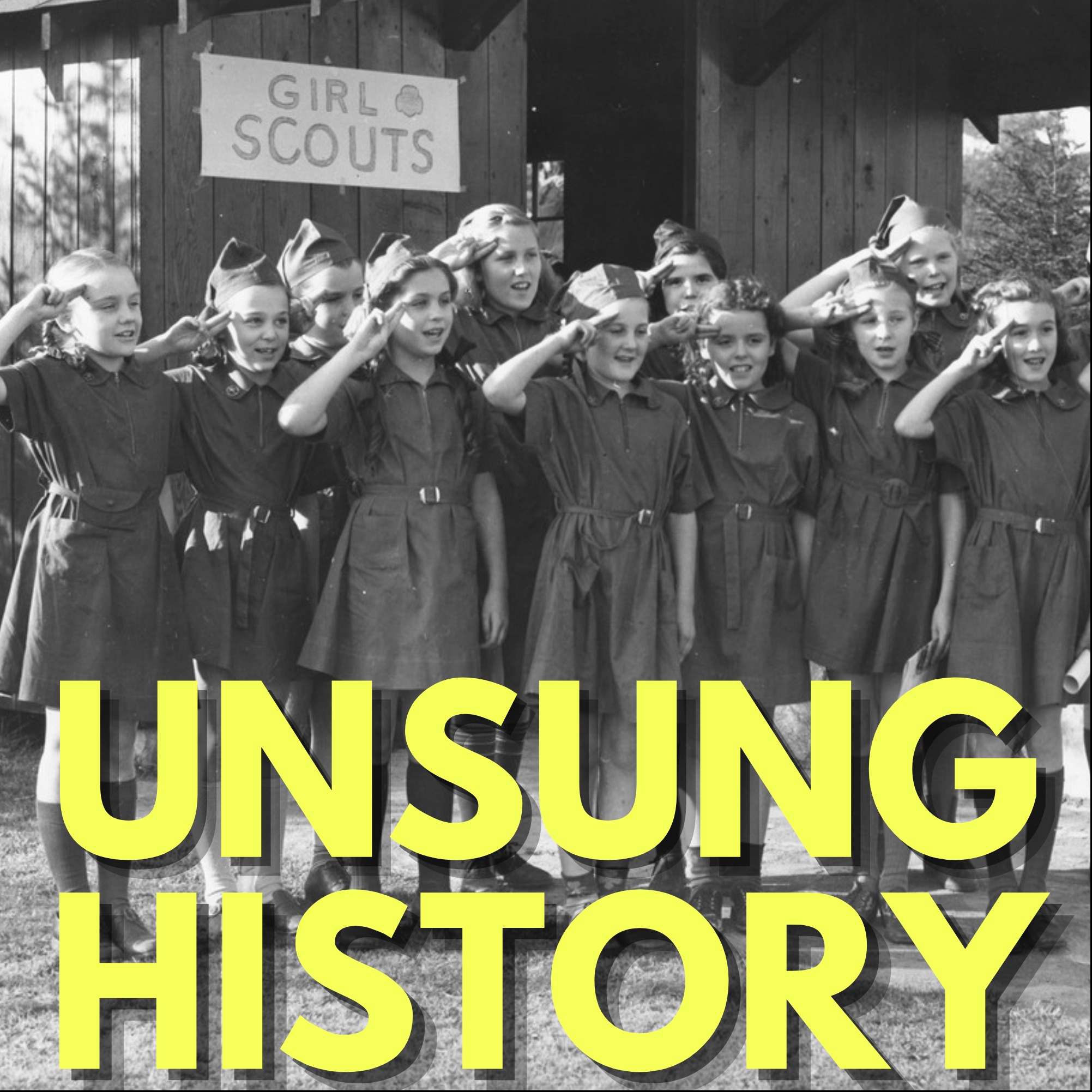
The Girl Scouts of the USA

In 1912, wealthy Savannahian Juliette Gordon Low supposedly called her cousin and exclaimed: “Come right over! I’ve got something for the girls of Savannah, for all of America, and for the world.” That something would become the Girl Scouts of the USA, an organization that throughout its history struggled to fulfill its initial promise of inclusion for all girls while trying to maintain an apolitical stance with deference to local councils. Joining me in this episode is Dr. Amy Farrell, the Jame...
Guest: Amy Farrell
200
March 31, 2025

The Enslaved Mariners on the Crews of Brazilian Slave Ships

On the slave ships that sailed between Salvador da Bahia, Brazil, and the West Coast of Africa from the 16th through the 19th Centuries, the crews included not just white sailors but also Black mariners, including a significant number of crewmen who were themselves enslaved. These enslaved mariners were not just a source of inexpensive labor but were also valued for their geographic, linguistic, and cultural skills, and they, in turn, could use the opportunity of labor on slave ships as a means ...
Guest: Mary Hicks
199
March 24, 2025

Ruth Reynolds & Puerto Rican Independence

Ruth Reynolds, born in the Black Hills of South Dakota in 1916 to a strict Methodist family, may have seemed an unlikely ally to the cause of Puerto Rican independence, but she devoted her life to what she saw as her “sacred and patriotic duty” as an American to convincing her country to withdraw from Puerto Rico “so that our nation may stand before the world free from any suggestion of imperialist ambition.” Facing surveillance by the FBI and insular police and even incarceration for her views,...
Guest: Lisa Materson
198
March 17, 2025

Wages for Housework

In March 1972, Selma James distributed a pamphlet that declared: “If we raise kids, we have a right to a living wage. . . WE DEMAND WAGES FOR HOUSEWORK. All housekeepers are entitled to wages. (Men too).” Soon it was a global movement, with Wages for Housework branches in the United Kingdom, Italy, the United States, and several other countries, and autonomous groups like Black Women for Wages for Housework and Wages Due Lesbians. Joining me in this episode is Dr. Emily Callaci, Professor of His...
Guest: Emily Callaci
197
March 10, 2025

Amelia Bloomer

Amelia Jenks Bloomer was many things: writer and publisher, public speaker, temperance reformer, advocate for women’s rights and dress reform, and adoptive mother. She was not the inventor of the trousers for women that came to bear her name – bloomers – although she wore them and wrote about them for many years. Throughout her life, even as poor health often stood in her way, Amelia Bloomer took action, never waiting for someone else to do what was needed. I’m joined in this episode by writer S...
196
March 3, 2025

The Color Line

My guest today is Dr. Martha S. Jones, the Society of Black Alumni Presidential Professor, professor of history, and a professor at the SNF Agora Institute at the Johns Hopkins University and author of The Trouble of Color: An American Family Memoir. In this book, Prof. Jones researches her family’s past to understand how each generation encountered and negotiated the color line, beginning with her great-great-great-grandmother who survived enslavement and raised a free family. Our theme s...
195
Feb. 24, 2025

The Women of the Universal Negro Improvement Association

The Universal Negro Improvement Association is often most closely associated with Marcus Garvey, but from the beginning, the work of women was essential to the development of the organization. Amy Ashwood co-founded the UNIA with Garvey, and it was her connections and capital that launched the Negro World newspaper, but after her brief marriage to and divorce from Garvey, she was removed from the UNIA and the newspaper. Other women, like Garvey’s second wife, Amy Jacques Garvey, and actress Henr...
194
Feb. 17, 2025

The Racist History of Property Taxes in the United States

After emancipation, formerly enslaved Black Americans knew that the key to economic freedom was land ownership, but as soon as they began to acquire land, local tax assessors began to overassess their land and exact steep penalties if they couldn’t pay the resulting inflated property taxes. For the past 150 years, all over the country, the same story has played out, with African Americans paying disproportionately higher property taxes, whether due to systemic inequities or corrupt local officia...
193
Feb. 10, 2025

Ericka Huggins & the Black Panther Party

For Ericka Huggins, the March on Washington for Jobs and Freedom, which she attended at just 15 years old, was a turning point in her life, inspiring her toward activism. She later joined the Black Panther Party, and after being incarcerated as a political prisoner, served as Director of the acclaimed Oakland Community School and became both the first Black person and the first woman appointed to the Alameda County Board of Education. She continues her activism work today in the fields of restor...
192
Feb. 3, 2025

Land Displacement & the Agua Caliente Band of Cahuilla Indians

Thousands of years ago, a band of Cahuilla Indians migrated south into the Coachella Valley, calling the area Séc-he, meaning boiling water. The Mexicans translated this as agua caliente (hot water), which is the name still used today. As the United States extended its territory into California, the Agua Caliente were forced onto a reservation, and then, as the Southern Pacific Railroad was granted land in the region, the reservation was carved up into a checkerboard pattern. It took decades of ...
191
Jan. 27, 2025

The History of Interracial Marriage in Mississippi

In 1865, when Black people in Mississippi first gained the legal right to marriage, so-called Black Codes outlawed interracial marriage, punishable by life in prison. Five years later, Republicans in the Mississippi state legislature repealed the Black Codes and legalized interracial marriage, but the law was reversed again ten years later when Democrats took control. In 1890, a new state Constitution, erasing all the racial progress of the 1868 one, enshrined a prohibition on interracial marria...
190
Jan. 20, 2025

The Panama Canal

The completion of the Panama Canal in 1914 positioned the United States as a global power, but the U.S. didn’t complete the feat single-handedly. It required land from Panama, equipment and information from the failed earlier effort by the French, and, importantly, tens of thousands of laborers from around the Caribbean. Decades later the Panamanians finally gained control of the canal zone and then the canal itself, but the labor – and sacrifice – of the Afro-Caribbean workers still deserves gr...
Guest: Julie Greene
189
Jan. 13, 2025

The Women of the Rendezvous Plantation on Barbados in the 17th Century

In 1686, Susannah Mingo, Elizabeth Atkins, Dorothy Spendlove, and their children, all of whom were half-siblings, along with some of their children's other half-siblings and their children's father, boarded a ship headed from Barbados to England, where they would live out their lives. It wasn’t unusual for a plantation owner like John Peers to impregnate both his enslaved Black laborers and his white servant, but it was unusual for him to acknowledge his illegitimate offspring, baptize them, bri...
Guest: Jenny Shaw
188
Jan. 6, 2025

Henry Christophe: The King of Haiti

Henry Christophe, one of the heroes of the Haitian Revolution, was, from 1811 to his death in 1820, King Henry I of the Kingdom of Haiti, the first, last, and only King that Haiti ever had. This week we look at Christophe’s meteoric rise from being born enslaved on an island hundreds of miles from Haiti to fighting in the American Revolution to serving as a general in the Haitian Revolution to being king of all he surveyed, until it all came crashing down around him. Joining me in this episode i...
Guest: Marlene Daut
187
Dec. 30, 2024

The Surprisingly Salacious History of the Modern Restaurant

If you were to head to Paris in the mid-eighteenth Century and ask for a restaurant, you might be handed a bowl of meat bouillon, prepared in such a way as to improve vigor and perhaps even sperm production. Restaurant referred first to the broth itself and then to the eateries in which men, and less frequently women, could eat said broth. As restaurant came to mean the luxurious establishment at one which could eat an elaborate menu of delicate food items prepared by talented chefs, sex stayed ...
186
Dec. 23, 2024

Frances Perkins

On March 4, 1933, Frances Perkins was sworn in as the 4th Secretary of Labor. It was the first time in United States history that a woman served in the Cabinet, only 13 years after the ratification of the 19th Amendment gave women the right to vote. Perkins came into office with a long list of to-do items, and she succeeded in accomplishing nearly all of them in her long tenure, as a central architect of many of the programs of the New Deal, especially the Social Security Act. More quietly, but ...
185
Dec. 16, 2024

Florence Price & the Black Chicago Renaissance

On June 15, 1933, the all-white, all-male Chicago Symphony Orchestra performed Florence Price’s award-winning Symphony Number 1 in E minor, the first institution of its caliber to play the work of a Black woman composer. It was a monumental achievement, but not one that Price achieved alone. She was supported by a sisterhood of Black women who created an environment in Chicago in which composers and performers like Price and Margaret Bonds could find success. Joining me in this episode is musico...
Guest: Samantha Ege
184
Dec. 9, 2024

The Women Physicists who Fled Nazi Germany

As the Nazis rose to power in Germany, life became increasingly hostile for women scientists, especially women of Jewish descent, but also those who expressed anti-Nazi sentiments. The sexism in academic that had held them back in their careers also made escape from Germany difficult, as they didn’t look as strong on paper as their male counterparts. But four women physicists – Hertha Sponer, Hildegard Stücklen, Hedwig Kohn, and Lise Meitner – managed to flee, taking their scientific knowledge a...
183
Dec. 2, 2024

The Women who Entered the Federal Workforce during the Civil War Era

As the federal workforce grew during the Civil War, department heads began employing women, without any explicit authorization from Congress that they could do so. When Congress finally acknowledged the employment of women in federal departments in 1864, it set their salary at $600 a year, half of what the lowest-paid men clerks were making. Surprisingly, though, a few years later Congress debated – and nearly passed – a resolution requiring equal pay for women employed by the federal government...
182
Nov. 25, 2024

The Northern Manufacturers of Southern Plantation Goods

Plantation owners in the Southern United States regularly furnished their enslaved workers with goods – clothing, shoes, axes, and shovels, that had been manufactured in the North. Many Northern manufacturers specifically targeted the Southern plantation market, enticed by the prospect of selling cheap goods on a regular schedule. While in some cases the Northern manufacturers supported surprising politics – joining the Republican Party and donating to Abolitionist causes – they had no qualms ab...
Guest: Seth Rockman
181
Nov. 18, 2024

Lily Dale

In 1879, a group of Spiritualists purchased 20 acres of land, halfway between Buffalo, New York, and Erie, Pennsylvania. The gated community they created, now a hamlet of Pomfret, New York, became known as Lily Dale. Each summer, people came to Lily Dale (and still come) to speak with the dead through Lily Dale’s many licensed mediums. In its early years, modern Spiritualism, which began with the young Fox sisters (Maggie and Kate), often intersected with Women’s Suffrage, and suffragists like S...
Guest: Averill Earls
180
Nov. 11, 2024

Isabel Kelly

Isabel Truesdell Kelly earned her PhD in Anthropology from the University of California, Berkeley, in 1932, with a dissertation on the “Fundamentals of Great Basin Culture,” having researched the Northern Paiute and Coast Miwok Indigenous cultures of Northern California. After graduating she led excavations in Mexico and then began a career as an anthropologist with the US State Department, which had a growing interest in assisting the scientific and technological development of countries like M...
179
Nov. 4, 2024

The History of the Electoral College

At the end of August 1787, after three long months of debate and deliberation, the Constitutional Convention had neared the end of its work. They were poised at that time to write into the Constitution that the President of the United States would be elected by the legislature, but at the last minute they referred the matter to the Committee on Unfinished Parts to resolve. It was that committee, guided by future president James Madison, that drafted a compromise Electors plan, answering the conc...
178
Oct. 28, 2024

Baseball & the Chinese Educational Mission of the 1870s

In the 1870s, 120 Chinese boys came to New England as part of the Chinese Educational Mission. The boys studied at prep schools and colleges, and while they continued their lessons in Chinese language and culture, they also learned about the culture of their adopted homeland, including the local sports, like baseball. By the mid-1870s, some of the Chinese students had formed a semi-pro baseball team called the Celestials that competed on the regional circuit. With growing anti-Chinese sentiment ...
Guest: Ben Railton